How a Restaurant Feasibility Study Reaches Its Verdict: Our GCC Method, Sheet by Sheet (Part 2 of 2)
The short answer. Once the inputs are built, a feasibility study turns them into five answers an investor needs: what the restaurant earns after every tax, how that changes over five years, how far sales can fall before it loses money, what happens when they do, and whether the cash lasts through a slow first year. Then a person writes down why each number is believable, and the model applies hard red lines that no score can override. The result is one of three verdicts: Go, Go with Conditions, or Don’t Go.
Next step. If you have not read it, start with Part 1: from the brief to the cost engine. To test your own numbers today, try our break-even calculator, or order a study for Dubai and the UAE or Saudi Arabia: USD 1,999 for one location, in seven working days.
Part 1 built À La Rose, our sample 100-seat French café and brasserie in Dubai’s DIFC, from the inputs up: AED 12.51 million to open, AED 19.87 million of sales engineered from the menu, and a cost engine of about 250 rows tested against Gulf ranges. Part 2 is where those inputs face the questions that decide whether money moves. Every image is a sheet from the same model.
Step 8. Profit and loss, after every tax
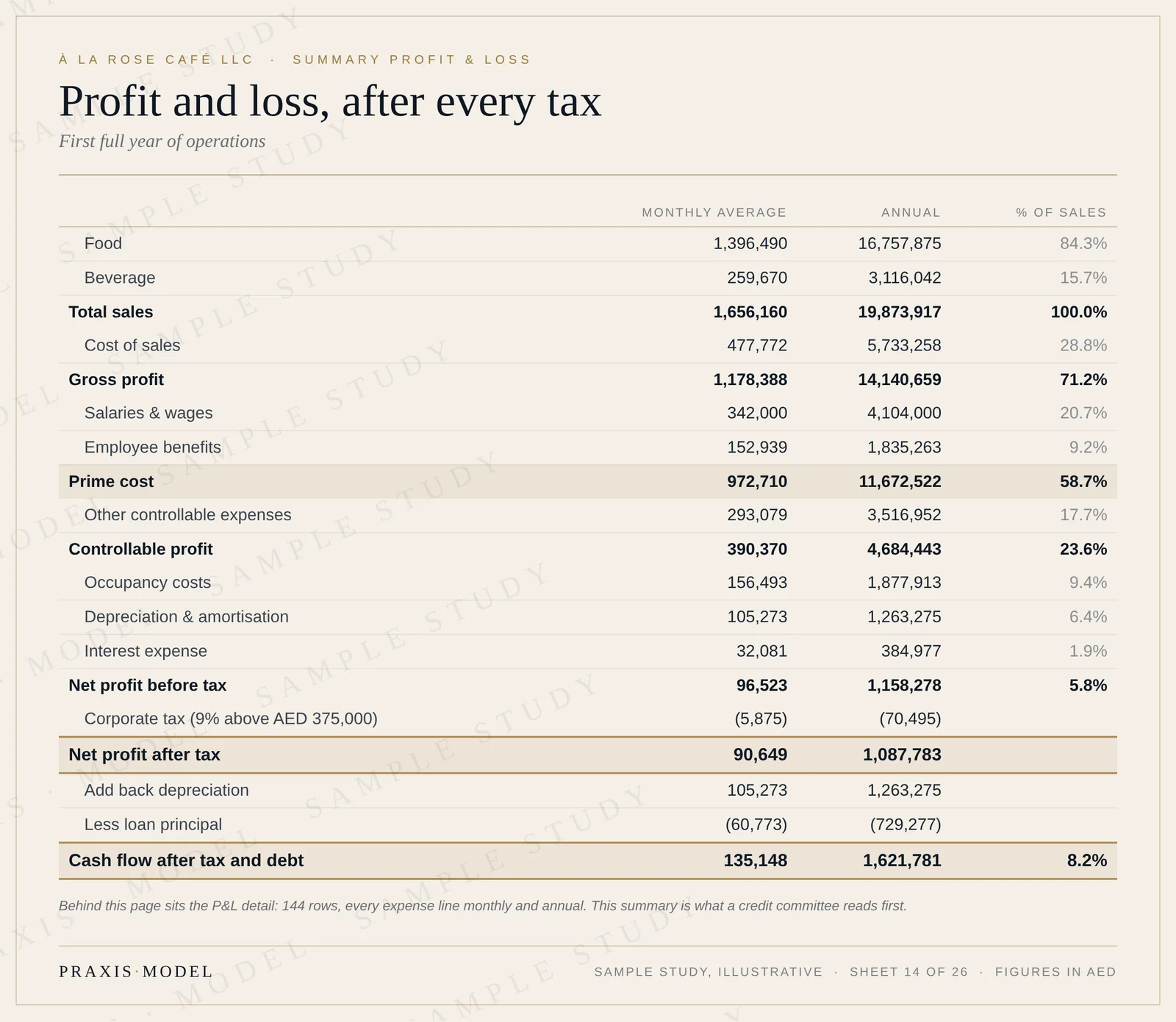
The profit and loss is built twice. The detailed version runs 144 rows, every expense line monthly and annually. The summary is what a credit committee reads first, and it is ordered the way restaurant operators think, not the way auditors file.
- Gross profit after food and drink costs: 71.2 percent of sales.
- Prime cost, cost of sales plus payroll: 58.7 percent. This is the single number that best predicts whether a restaurant survives. High performers hold 55 to 60 percent; above 65 is a red line.
- Controllable profit, what the management team is responsible for: AED 4.68 million, 23.6 percent.
- Net profit before tax after rent, depreciation and interest: AED 1.16 million, 5.8 percent.
- Net profit after tax, with UAE corporate tax at 9 percent above AED 375,000: AED 1.09 million, 5.5 percent.
- Cash flow after tax and loan repayments: AED 1.62 million. This is the money partners can actually take out, and it is the line most pitch decks leave off.
Step 9. Five years, with costs that creep
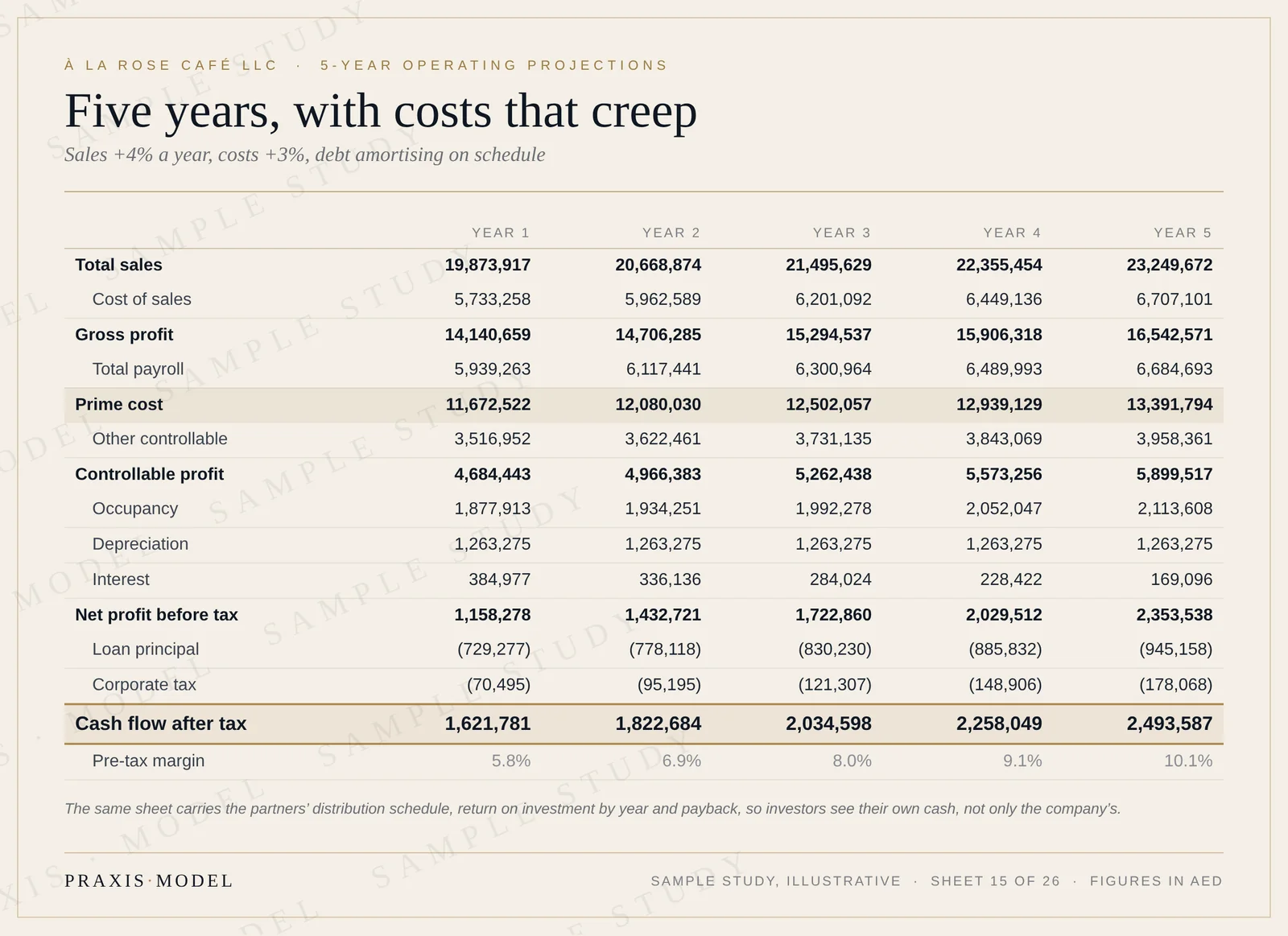
A single good year proves little. The five-year projection grows sales at 4 percent a year and costs at 3 percent, so inflation is in the model rather than in a footnote. Depreciation stays flat, interest falls as the loan amortises, and principal repayments rise. Pre-tax profit climbs from AED 1.16 million to AED 2.35 million; the margin from 5.8 to 10.1 percent. Over five years the café throws off AED 10.2 million of cash after tax and debt.
The same sheet carries the partners’ own story: cash distributed to each of them by year, return on investment by year, and payback. In the sample, each partner’s AED 3.13 million comes back from distributions in about 3.3 years, and the first year returns 25.9 percent in cash on the equity. Investors see their own cash, not only the company’s.
Step 10. Break-even, in dirhams and in covers
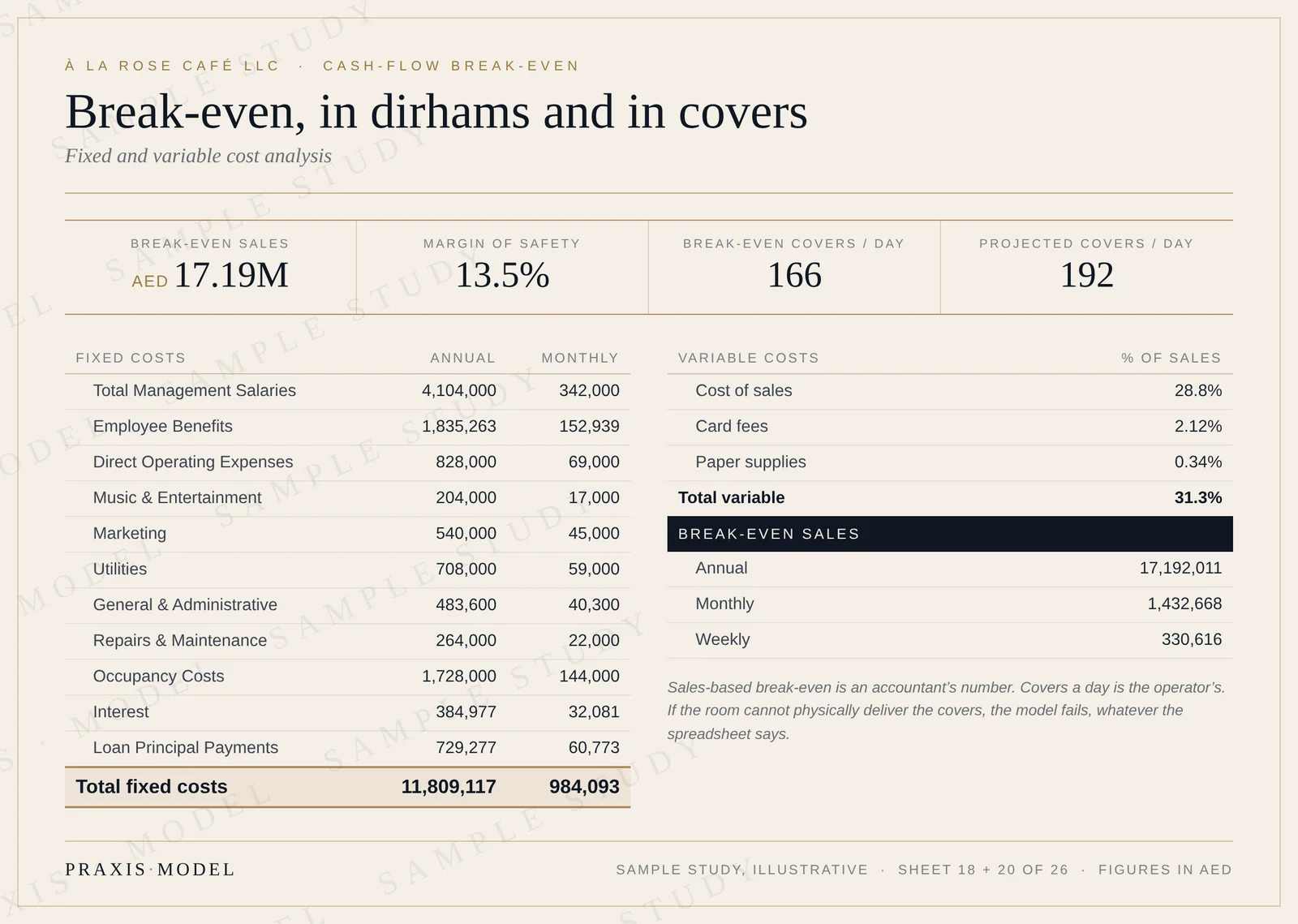
We calculate cash-flow break-even, which is stricter than the accounting version: fixed costs include loan principal, because the bank wants its money whether or not the café made a profit. Fixed costs come to AED 11.81 million a year. Variable costs are 31.3 percent of sales. So À La Rose breaks even at AED 17.19 million of annual sales, AED 1.43 million a month.
Then the number that matters to the person running the room. At an average of AED 285 per guest, break-even is 166 covers a day. The plan needs 192. That cushion of 26 guests a day is the margin of safety, 13.5 percent: the café can lose about one guest in eight, every day, and still not lose money. It cannot lose one in four. Our bar is 25 percent, so this is the first number the verdict will have to deal with. If break-even had needed more covers than the seats and opening hours can physically serve, the study would fail the plan regardless of the spreadsheet. We have seen that happen more often than founders expect.
Step 11. What breaks the model, and the honest first year
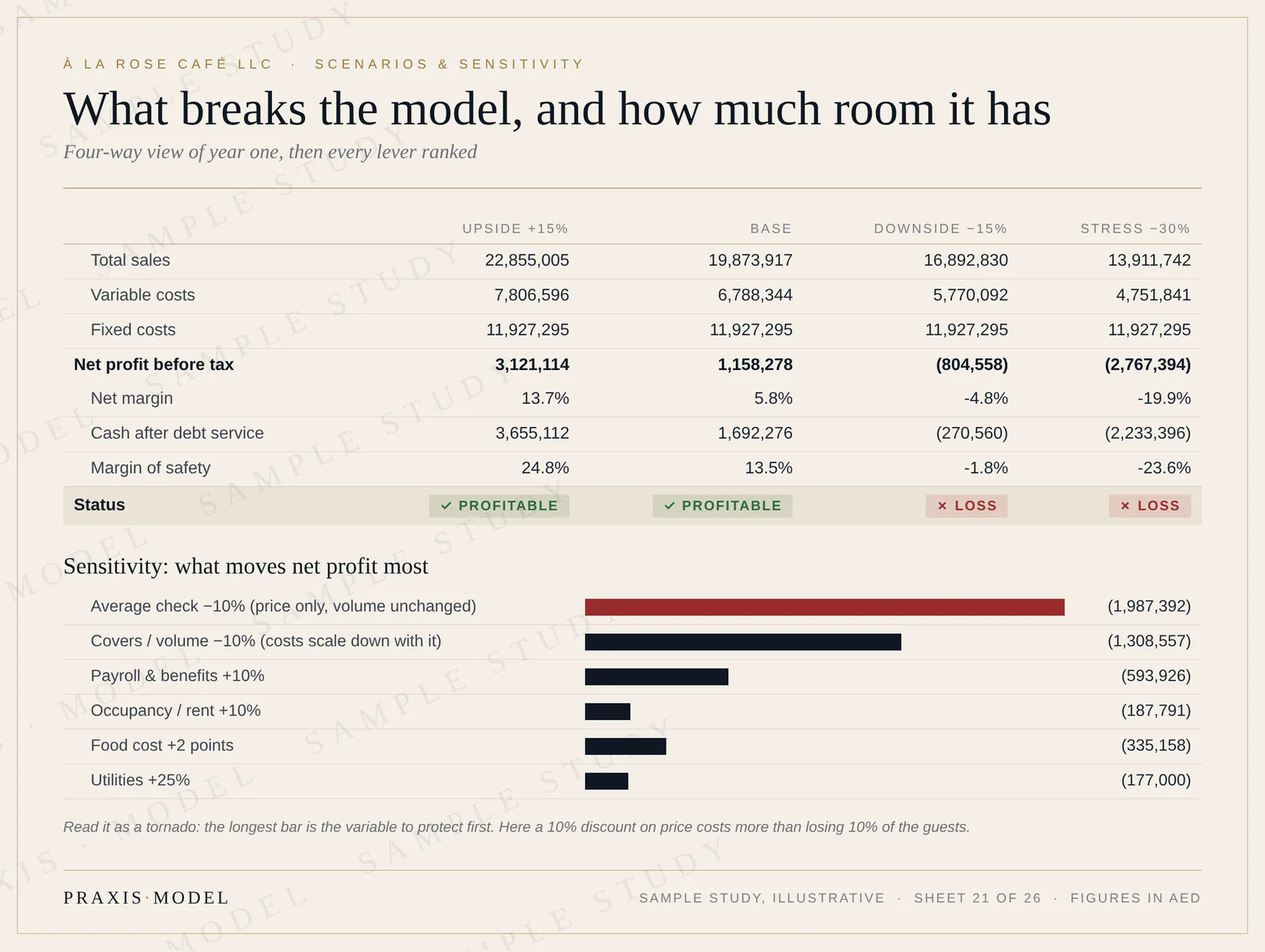
Every study we write answers one question plainly: what happens when things go wrong? The scenario sheet runs year one four ways. Sales 15 percent above plan. The plan. Sales 15 percent below, where À La Rose loses about AED 0.80 million a year before tax. And a stress case at 30 percent below, where it loses AED 2.77 million. Those losses are shown, not hidden, because they tell investors exactly how much room there is: not much. A 15 percent shortfall is an ordinary bad year in Dubai, and this plan does not survive one indefinitely. The working capital reserve buys time to correct course or exit, which is why the verdict carries conditions.
Below the scenarios sits the sensitivity ranking. Each lever is shocked on its own and ranked by damage. The result surprises most founders. A 10 percent price discount costs AED 1.99 million of profit; losing 10 percent of the guests costs AED 1.31 million. Discounting hurts more than an empty table, because costs fall with lost guests but not with lost price. Then payroll, food cost, rent and utilities, in that order.
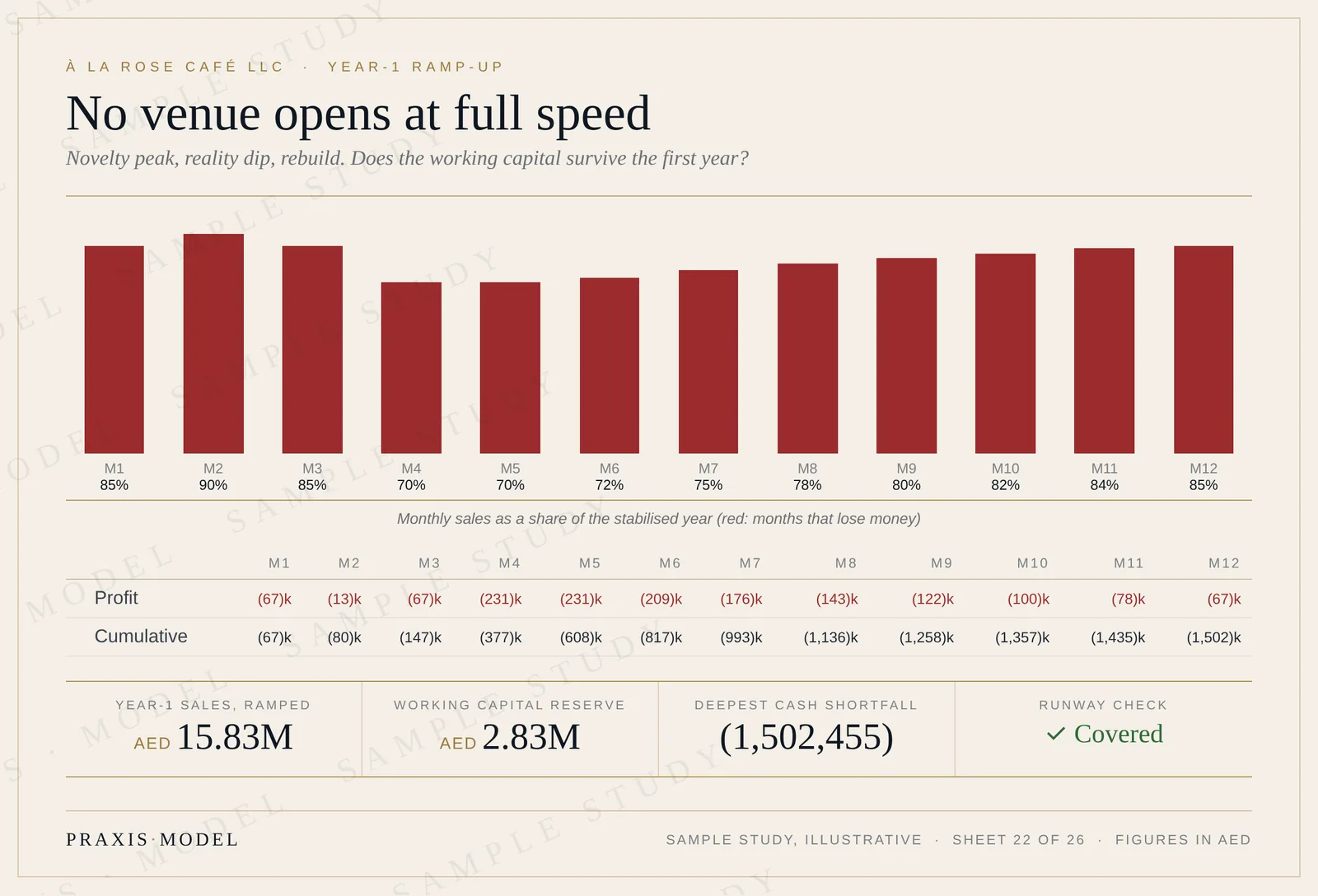
The last test is time. No restaurant opens at full speed, and the base profit and loss describes a stabilised year. So the ramp-up sheet models the first twelve months the way Gulf openings usually run: a novelty peak in the first quarter, a dip in months four to six, a slow rebuild. In the sample, year one reaches about 80 percent of stabilised sales, and at that level every month loses money: AED 1.50 million across the year. The question is not whether the dip comes but whether the cash survives it. Here the AED 2.83 million working capital reserve covers the whole shortfall with AED 1.33 million to spare. The model reports that as a runway check, and it is the reason working capital is calculated, never guessed.
Step 12. Tax and VAT, as cash
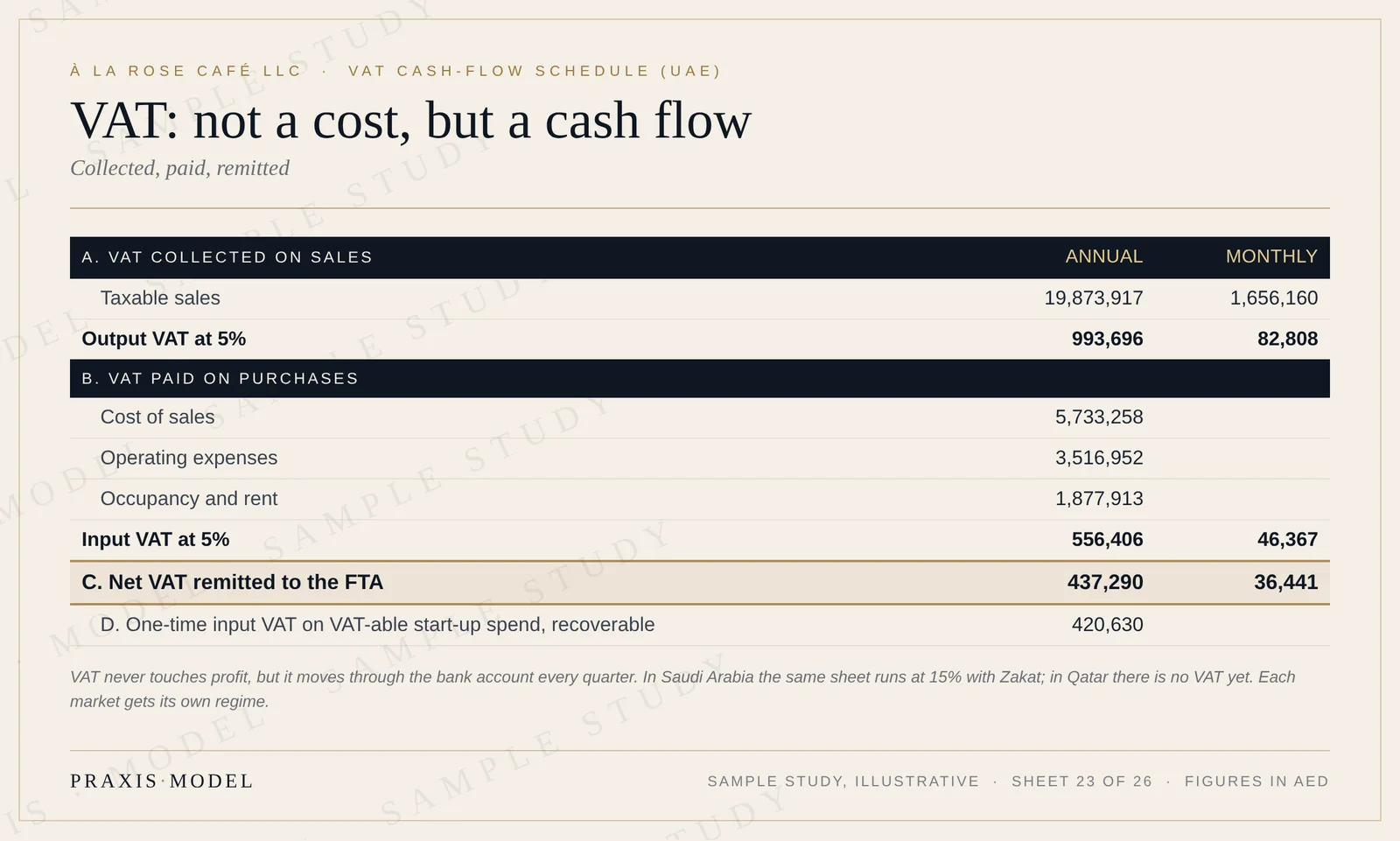
Corporate tax sits in the profit and loss. VAT does not, because it is not a cost; it is cash passing through the business. A separate sheet follows it. À La Rose collects AED 993,696 of VAT on its sales, pays AED 556,406 on its purchases, and remits the difference, AED 437,290 a year, to the Federal Tax Authority. It also tracks the one-time VAT paid on start-up spending, which is recoverable. Founders who forget either side get a surprise from the bank balance in the first quarter.
Each country version of the model runs its own regime in this sheet: 15 percent VAT and Zakat in Saudi Arabia, 10 percent in Bahrain, 5 percent in the UAE and Oman, none yet in Qatar.
Step 13. The Thesis: the spreadsheet proves what, the Thesis proves why
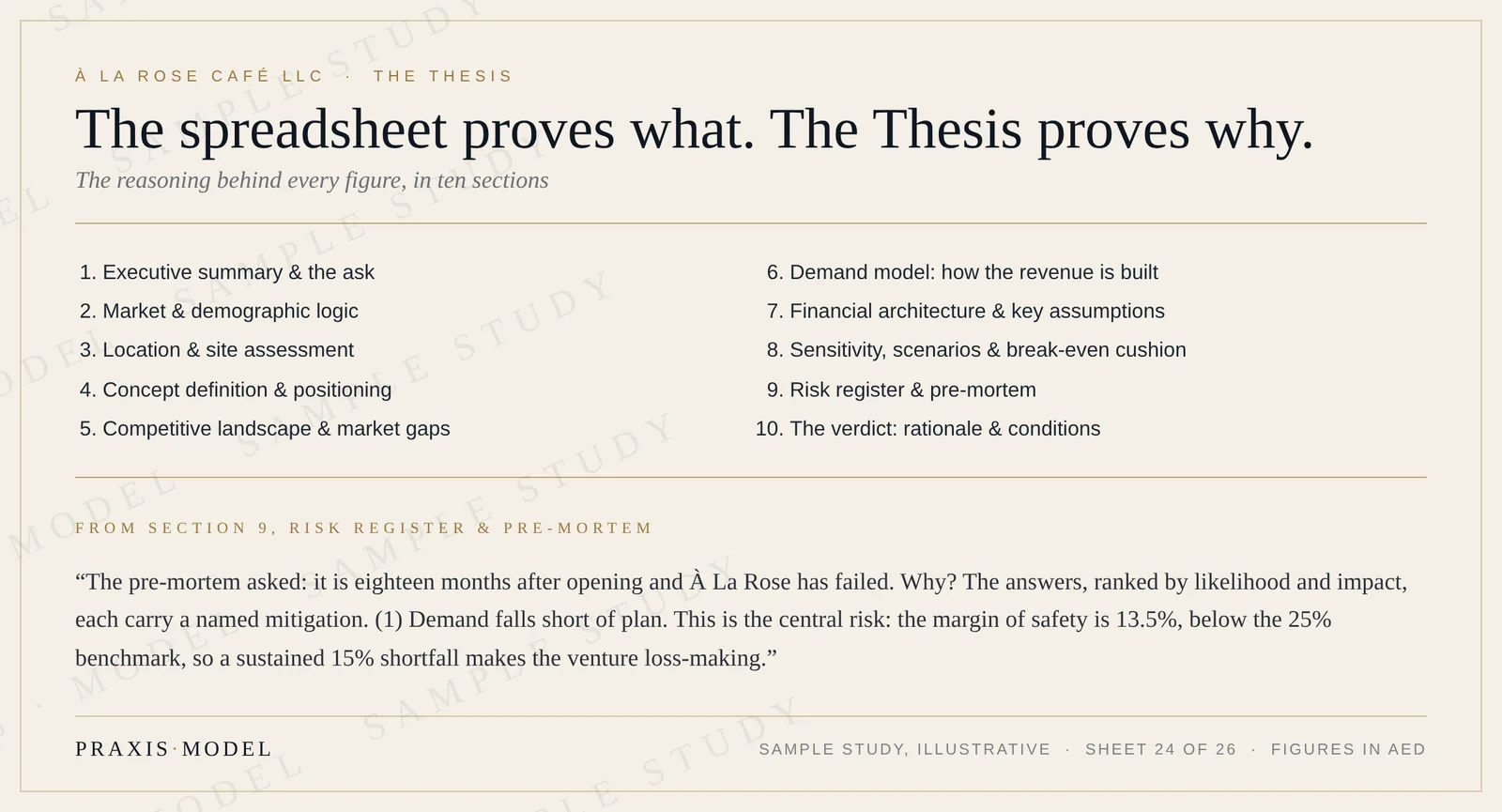
Numbers are easy to produce and easy to doubt. So every Praxis study ends in writing, in ten sections: the executive summary and the ask, the market and its demographics, the site and its catchment, the concept and its positioning, the competitive landscape, how the revenue is built, the financial architecture, sensitivity and break-even, the risk register, and the verdict.
The risk register is a pre-mortem. We imagine it is eighteen months after opening and the restaurant has failed, then list why, ranked by likelihood and impact, each with a named fix. For À La Rose the first answer is the obvious one: demand falls short, because a 13.5 percent margin of safety leaves little room. Another had already happened on paper: the original lease pushed occupancy to 10.7 percent of sales, and renegotiating the percentage-rent threshold brought it to 9.4 percent.
Step 14. The verdict, computed and argued
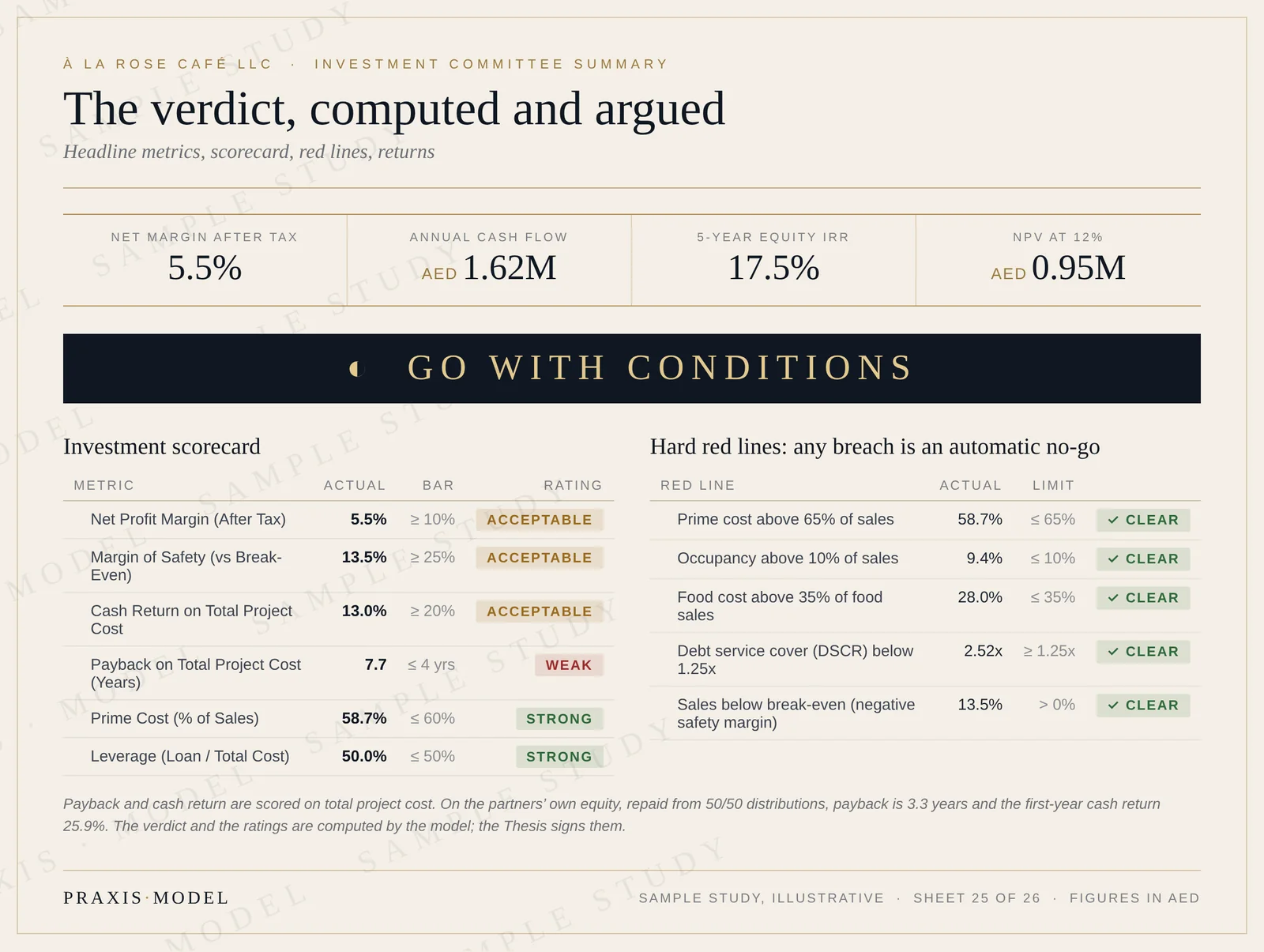
The final sheet is the investment committee summary. It does three things, and the order matters.
- It scores the project on six measures against fixed bars: net margin after tax (5.5 percent against at least 10), margin of safety (13.5 against 25), cash return on total project cost (13.0 against 20), payback on total project cost (7.7 years against 4), prime cost (58.7 against 60) and leverage (50 percent against 50). À La Rose scores 7 of 12: strong on cost control and leverage, acceptable on margin, safety and return, weak on project payback.
- It applies five hard red lines that override any score: prime cost above 65 percent, occupancy above 10 percent, food cost above 35 percent, debt service covered less than 1.25 times, or sales below break-even. One breach and the verdict is no, however good everything else looks. À La Rose clears all five; its debt is covered 2.5 times.
- It states the returns an investor compares across opportunities: a five-year equity internal rate of return of 17.5 percent, and a net present value of AED 0.95 million at a 12 percent hurdle.
The model computes Go with Conditions, and the Thesis, signed by a person, names them: the AED 18 million rent threshold must survive into the signed lease; three private events a week must be evidenced before signing, through corporate letters of intent or an events pipeline; covers are tracked weekly against 192 a day for the first two quarters, with a pre-agreed marketing response below 175; and prime cost stays under 61 percent in every month. A verdict with conditions is more useful than a bare yes, because it tells the partners exactly what to watch.
The sample shows one more thing worth seeing. The first complete draft of À La Rose did not pass. Its five-year return came out at 9.7 percent, below the 12 percent hurdle. We did not nudge the assumptions until the answer looked better; we went back to the evidence. Drinks were priced like a café, not like a DIFC venue, so they were reset to what five-star lists in the district charge once service charge and VAT are taken out. The launch budget was trimmed by AED 120,000. Private events went from two a week to three, and that became a condition the partners must prove, not a number they may assume. The result clears the hurdle, thinly, and the study says thinly. That is what making every mistake on paper looks like.
Every client study also carries a Survival Score: one number from 0 to 100, built from five weighted pillars, with danger flags that surface regardless of the score. A high number cannot hide a killer flaw.
What the investor receives
The model is the engine; investors rarely want to open a workbook. So the study can also be delivered as the Investor Edition: the same numbers, bound as a catalogue for banks, partners and landlords, with the concept brought to life. It is USD 499 and arrives three days after the study. You can page through the À La Rose edition before ordering anything.
What a feasibility study cannot do
It cannot make a weak concept strong or a bad site good. It cannot guarantee the future; it can only show which assumptions carry the result and how far they can move before the answer changes. And its quality is capped by its inputs, which is why Part 1 spends so long on evidence. What it can do is let you make every mistake on paper, where mistakes are cheap. If you are weighing someone else’s study, our ten-point checklist works on ours as well as anyone’s.
Frequently asked questions
What is a good margin of safety for a restaurant?
We look for at least 25 percent: projected sales at least a quarter above cash-flow break-even. Below 10 percent, a normal slow month can put the business into loss. The sample study shows 13.5 percent, 166 break-even covers a day against 192 planned, which is one reason its verdict carries conditions.
What prime cost should a restaurant in the Gulf target?
Prime cost, meaning food and drink cost plus total labour including benefits, typically runs 55 to 65 percent of sales for full-service restaurants in the Gulf. Strong operators hold 55 to 60 percent. Above 65 percent is a hard red line in a Praxis study and forces a Don’t Go verdict.
Can a feasibility study tell me not to open?
Yes, and that is its main job. A Praxis study ends in one of three verdicts: Go, Go with Conditions, or Don’t Go. Five hard red lines, covering prime cost, occupancy, food cost, debt cover and break-even, override any score, so a single breach means Don’t Go.
Does a restaurant feasibility study include VAT and corporate tax?
It should. Corporate tax belongs in the profit and loss, using each country’s rate and threshold. VAT is a cash flow, not a cost, so it needs its own schedule showing VAT collected, VAT paid and the net remitted, plus VAT recoverable on the build.
How is cash-flow break-even different from accounting break-even?
Accounting break-even covers costs in the profit and loss. Cash-flow break-even also covers loan principal repayments, which are cash out of the business but not an expense. It is the stricter test, and the one a lender cares about.
À La Rose is illustrative. The method is not. Every client study runs these fourteen steps in this order, in the market’s own currency, taxes and labour rules, and ends in a verdict a person signs.